Bitcoin (BTC) occupies a special status in the crypto space. As the first truly decentralized digital currency, it has grown into the most popular and valuable crypto asset. And while bear markets occasionally slow it down, most price predictions still see it reaching higher highs and breaking previous records.
Bitcoin has earned the moniker ‘digital gold’. And gold is too valuable to lose. So, for anyone holding or looking to hold the asset, securing it has become a top priority. Otherwise, you may lose access to your assets, a situation that may require professional recovery services if there’s to be any hope of recovery.
That said, securing your BTC entails two things: finding the right storage solution for your needs and observing the good practices required for that particular solution. To do this effectively, you must first understand how crypto storage works.
How Does Crypto Storage Work?
Digital currencies like BTC are held in crypto wallets. But the ‘holding’ is different from how a physical wallet holds your banknotes and coins.
Your crypto wallet doesn’t actually store your Bitcoin. The assets permanently live on the Bitcoin blockchain as bits of data. What your wallet does is show you the coins (bits of data) that belong to you.
How Does It Know?
While your Bitcoin wallet doesn’t hold your coins, it stores two very important pieces of data; your public and private keys. Your public key is your wallet’s public address on the blockchain. That matters because each asset on the blockchain is associated with a particular public address.
That’s how your wallet knows which coins belong to you. When you check your BTC balance, the wallet program looks for all bitcoins associated with your address, sums them up, and shows you the balance.
Private keys, on the other hand, act as proof of ownership of a crypto wallet. Think of them as the wallet’s digital signature. They prove who the owner is and are consequently used to sign off on transactions.
The blockchain assumes that anyone with a wallet’s private key owns the assets associated with its public address. This is what allows you to access and send/withdraw assets from your Bitcoin wallet. It also means that anyone with your wallet’s private keys can also access and send/withdraw your crypto.
Securing your Bitcoin involves keeping your wallet’s private keys safe. Your duty is to prevent these keys from falling into the wrong hands.
Storing and Securing Your Assets
You have several options when it comes to choosing a wallet for your BTC. These generally differ depending on how they store private keys and your choice will depend on your specific needs. But whichever option you pick, the goal remains the same; keep your private keys safe.
Here’s a look at crypto storage solutions and their best practices.
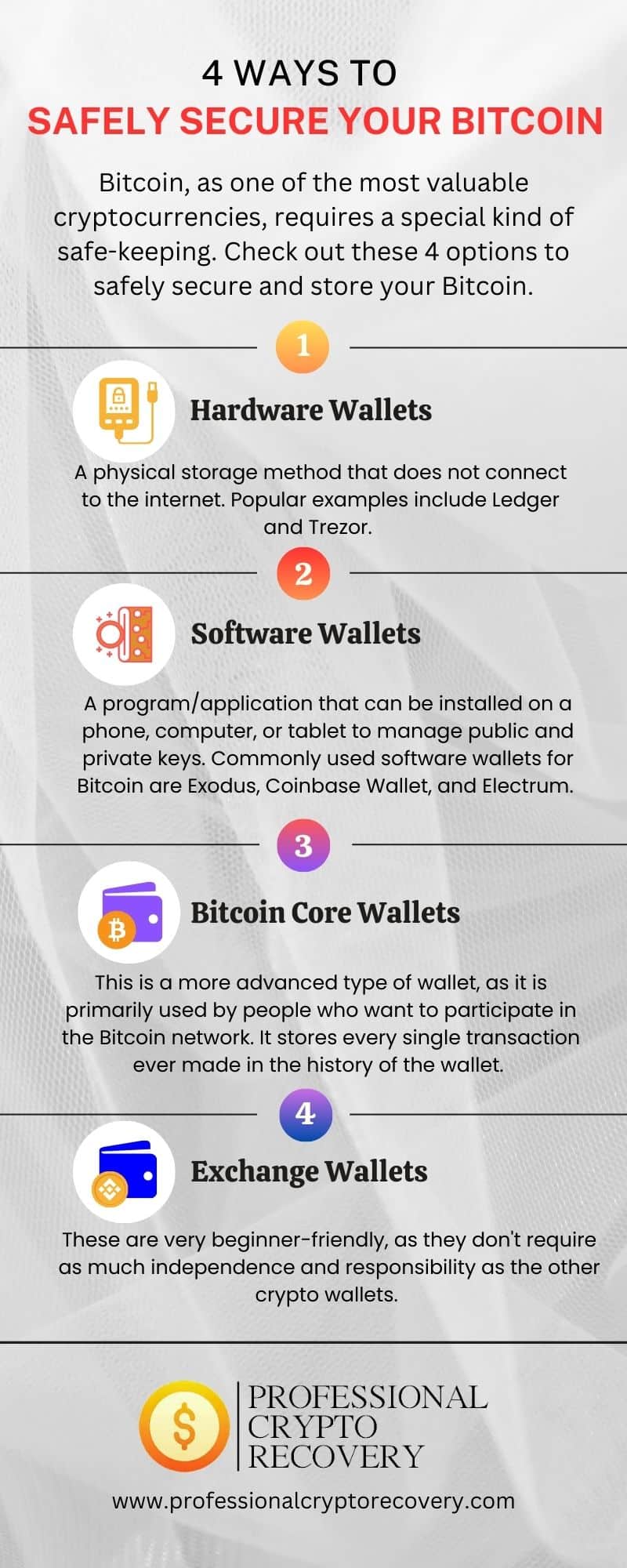
Hardware Wallets
A hardware wallet is a physical device specially designed to store public and private keys. Popular hardware wallet brands include Ledger and Trezor. They are an attractive option for users looking to hold their Bitcoin long-term with occasional transactions in between.
By themselves, hardware wallets cannot connect to the internet. They are also designed so that the private keys are always offline, even when signing transactions. That’s important because it prevents hackers from stealing the device’s private keys. They are typically considered the safest way to hold your Bitcoin.
However, just having a hardware wallet isn’t enough. You’ll need to take measures to secure it, like being careful about where you buy the device.
Generally, you want to buy your hardware wallet directly from the manufacturer rather than a third-party reseller. You also want to buy a new device, not a used one.
With a reseller, there is a possibility that the device has been tampered with to create a backdoor that will give them access to your Bitcoin. By buying your wallet directly from the manufacturer, you eliminate that risk.
Another important measure is storing your seed phrase safely. A seed phrase is a sequence of 12-24 random words that are generated by most crypto wallets at the moment of creation. It is a crucial piece of crypto ownership because it can be used to generate a wallet’s public and private keys. It is provided as a backup that lets you create a copy of your wallet if you ever lose access to it.
However, your seed phrase’s ability to generate your private keys also makes it a security risk. In the wrong hands, it can be used to generate your keys and drain your BTC. Soring your seed phrase in a safe and secure place, like a safe or vault, is just as important as storing your hardware wallet.
Note that crypto wallets come with basic security features, like a PIN/password to protect your wallet from unauthorized access. Hardware wallets add an extra feature on top of that by incorporating a passphrase. When used in combination with your seed phrase, it creates a hidden wallet for your Bitcoin.
The hidden wallet cannot be accessed without both the seed phrase and passphrase. It’s an extra security measure in case someone steals the seed phrase.
Software Wallets
A software wallet is a program or application you can install on your phone, computer, or tablet to manage your public and private keys. Popular Bitcoin wallets include Exodus, Coinbase Wallet, and Electrum.
Like hardware wallets, these provide a seed phrase for backup and let you set a password to prevent unauthorized access. But unlike hardware wallets, they are online. They are more convenient for users who regularly conduct transactions. However, there is a cost.
Software wallets require the device to be connected to the internet to work, which can expose your private keys to hackers. They’re also quite vulnerable to phishing scams. They are not as safe as hardware wallets.
Different software wallets, however, offer different security levels. Phone wallets are more secure than desktop wallets, while browser extension wallets are the least secure.
If you choose to use one, you’ll need to observe seed phrase best practices. These include not storing the seed phrase online. Instead, write it down on a piece of paper and securely store the paper in a vault or safe.
Bitcoin Core Wallet
In addition to your private and public keys, crypto wallets also store your transaction history. Core wallets take it a notch higher; they store every transaction ever made by every user. In essence, you have the complete history of the blockchain. By running a core wallet, you’re also running a full node of the blockchain on your computer.
Core wallets are used by people who want to participate in the network. If you’re looking to do the same on the Bitcoin network, Bitcoin Core is the wallet to choose.
Bitcoin Core doesn’t support seed phrases. Instead, it stores its private keys in a file known as wallet.dat. So, securing your wallet means keeping this file safe.
A good way to do this is to use a passphrase. Bitcoin Core gives you the option to use a passphrase to encrypt the wallet.dat file so that if anyone ever manages to steal it, they will be unable to open it. This passphrase should remain a secret. If you decide to write it down, store it somewhere where no one else can access it.
However, theft isn’t the only risk to your wallet.dat file. Since the file is stored on your computer, it can be accidentally deleted, damaged by a virus, or lost if you lose your device. It’s a good practice to create multiple copies of the encrypted file and store them on flash drives.
If you have lost access to an old Bitcoin wallet due to a forgotten password, damaged wallet file, or missing backup information, professional Bitcoin wallet recovery help may be able to assist in determining whether recovery is possible.
Exchange Wallets
Regular traders can also use an exchange wallet. It’s the wallet you receive when you sign up for a crypto exchange like Binance or Coinbase.
The convenience it offers for trading is unmatched. However, there is a huge trade-off; the platform retains control of your private keys and thus, your Bitcoin. You can look at this as taking a lot of the safety responsibility off your shoulders.
And while that would be correct, it also means that you can lose your Bitcoin through no fault of your own. For example, this happened with Mt. Gox when it was hacked in the early days of crypto. A more recent example is FTX. The exchange collapsed due to mismanagement by executives, and users lost their assets as a result.
So, What Is the Best Way to Secure Your Bitcoin?
Hardware wallets are the most secure way to store Bitcoin (BTC). However, they may not fully serve your needs, especially if you conduct transactions regularly. In this case, software and exchange wallets will do just fine. If you want to participate in the Bitcoin network, Bitcoin Core is the wallet of choice.
New methods of storing your seed phrase securely keep emerging. One of the best is crypto metal steel wallets. These are metal capsules or cassettes that let you use metal tiles to create and store a copy of your recovery phrase.
All in all, to keep your Bitcoin safe, it is important to guard your seed phrase, passphrase, and password. And if something happens, call Professional Crypto Recovery to see if we can help you get your crypto back.